This article provides a brief overview of the “Hygro-Triggered Giant Spherulites Formation (HT-GSF)” method, which I discovered around 2017 while in graduate school.
Since the first question is likely “how big are these giant spherulites, and what do they actually look like?”, I’ll start by showing the substrates before and after growth, photographed with an iPhone camera.
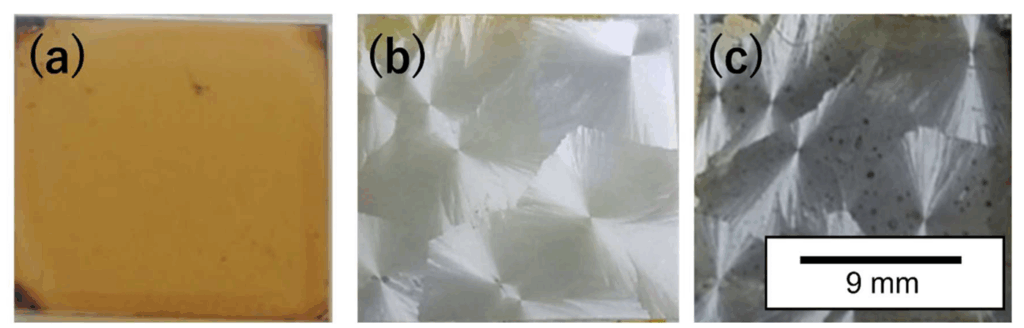
The substrates are ordinary cover glasses*¹ that have been subjected to ultrasonic cleaning and ozone treatment.
*¹ Cover glasses from Muto Pure Chemicals, made from Hydrolytic Class 1 glass.
In (a), a solution prepared by dissolving 3MAI and PbCl₂ in DMF at 40 wt% was spin-coated at 2000 rpm for 30 s inside a nitrogen- or argon-filled glovebox, followed by annealing at 60 °C for 10 min in the glovebox.
The yellow color of the film indicates that, in MAPbI₃₋ₓClₓ, the value of x is large—meaning the composition is close to MAPbCl₃ (confirmed by XRD).
Next, the glass substrate bearing this unstable material is taken out of the glovebox after being placed in a tightly sealed container to prevent any exposure to ambient air.
The crucial step starts here.
The container is opened in an environment of ~60–65% RH at around 25 °C. At that moment, the substrate briefly turns black, then becomes slightly gray, and the hygro-triggered giant spherulite growth phenomenon begins.
Only a few nuclei form on an 18 mm × 18 mm substrate, and from each nucleus an ultra-giant spherulite grows radially in 360° until it covers the entire substrate.
This figure captures the spherulites expanding at a uniform rate outward from the nucleus.
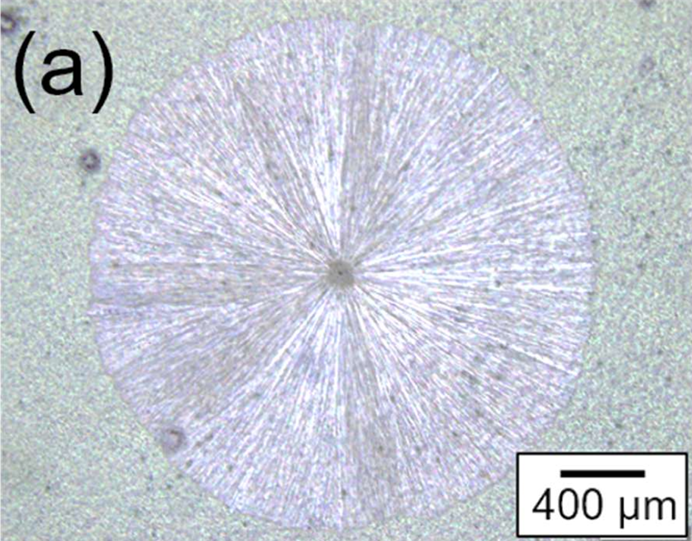
We also recorded optical microscopy videos in which the emerging ultra-giant spherulite “swallows” the fine particles around it as if devouring them.
XRD reveals that the resulting spherulites are hydrates of MAPbI₃₋ₓClₓ.
Moreover, MAPbI₃₋ₓClₓ obtained by annealing these spherulites is highly durable: it shows little degradation even after exposure to ambient air. XRD also indicates strong preferred orientation along the (110) plane.
After I stumbled upon this phenomenon by chance around 2017, I wanted to publish it in a form the world could understand. But at the time I was a complete novice when it came to spherulites, and providing a theoretical explanation on my own was extremely difficult. As the discoverer, I also never found anyone who could discuss it with me as an equal. As a result, an astonishing eight years passed before my single-author preprint was posted on ChemRxiv in June 2025.
In the end, I was able to establish myself as the first discoverer of this phenomenon in the scientific community—but I also realized that this alone won’t change the world.
Because far fewer people are genuinely interested in science today.
When I look at X or Threads, most posts seem to be about money or appearance, and posts about scientific discoveries appear to be quite rare.
And yet, even the smartphones we use every day are built on the foundation of accidental discoveries like this and the steady efforts of scientists.
Science is an accumulation of facts. It was hard, but I want a world where taking on challenges feels natural—and where those who succeed receive the recognition and rewards they deserve. That’s what I hope for.
I still have a long way to go, and I’m not all that impressive yet—but this discovery is a turning point for me. From here, I’m going to take on much bigger challenges. Watch me. I’ll make it happen.
If you’re interested, feel free to DM me.
If you would like to cite this work, please use the format below. I am currently writing Version 10.
Hiroto T. Murakami. In situ observation of ultra-giant spherulites in perovskite hydrates. ChemRxiv. 11 March 2026.
DOI: https://doi.org/10.26434/chemrxiv-2025-0dxhw/v9
Hiroto T. Murakami (村上寛虎)
Leave a Reply